
On Care, Meaning, and Misalignment

My parents have passed, and there are no people left for me to hurt with this confession: I do not have access to faith. I never did.
By “faith,” I mean the capacity to organize one’s understanding of the world and one’s life around beliefs that are not contingent on empirical verification, and to experience those beliefs as coherent, trustworthy, and sustaining.
Not because I do not understand it. I do. I have spent my life inside its orbit—watching it structure lives, sustain people, compel action, and create meaning. I can map its functions and name its effects.
I just cannot connect to it.
Faith has played a substantial role in my life. I grew up in a strict religious household, married a man of deep faith, and have moved and worked in Catholic spaces for nearly fifteen years. Faith sustained my mother through fifty years of disabling chronic illness. It is a source of comfort and community for my husband and his family in times of joy and sorrow. I have also seen faith call people to action in service of the marginalized and for the common good.
I want to be explicit about why I am naming so much of my own context here. It is not incidental detail. It is to make clear that what I am describing is not a lack of exposure, literacy, or effort. I have lived within and alongside faith long enough to understand its language, its practices, and its effects. The distance I am describing is not unfamiliarity. It is something else.
Faith is consequential. It is real in its effects, even if it is intangible in form. I imagine it like the sun—a force capable of sustaining or scorching, illuminating or blinding. My parents’ faith structured my childhood and shaped the trajectory of my life. Watching how faith compelled my husband to care for others is part of why I fell in love with him.
I do not question that faith does something. Like music can move the heart or wind can topple a building, it has force.
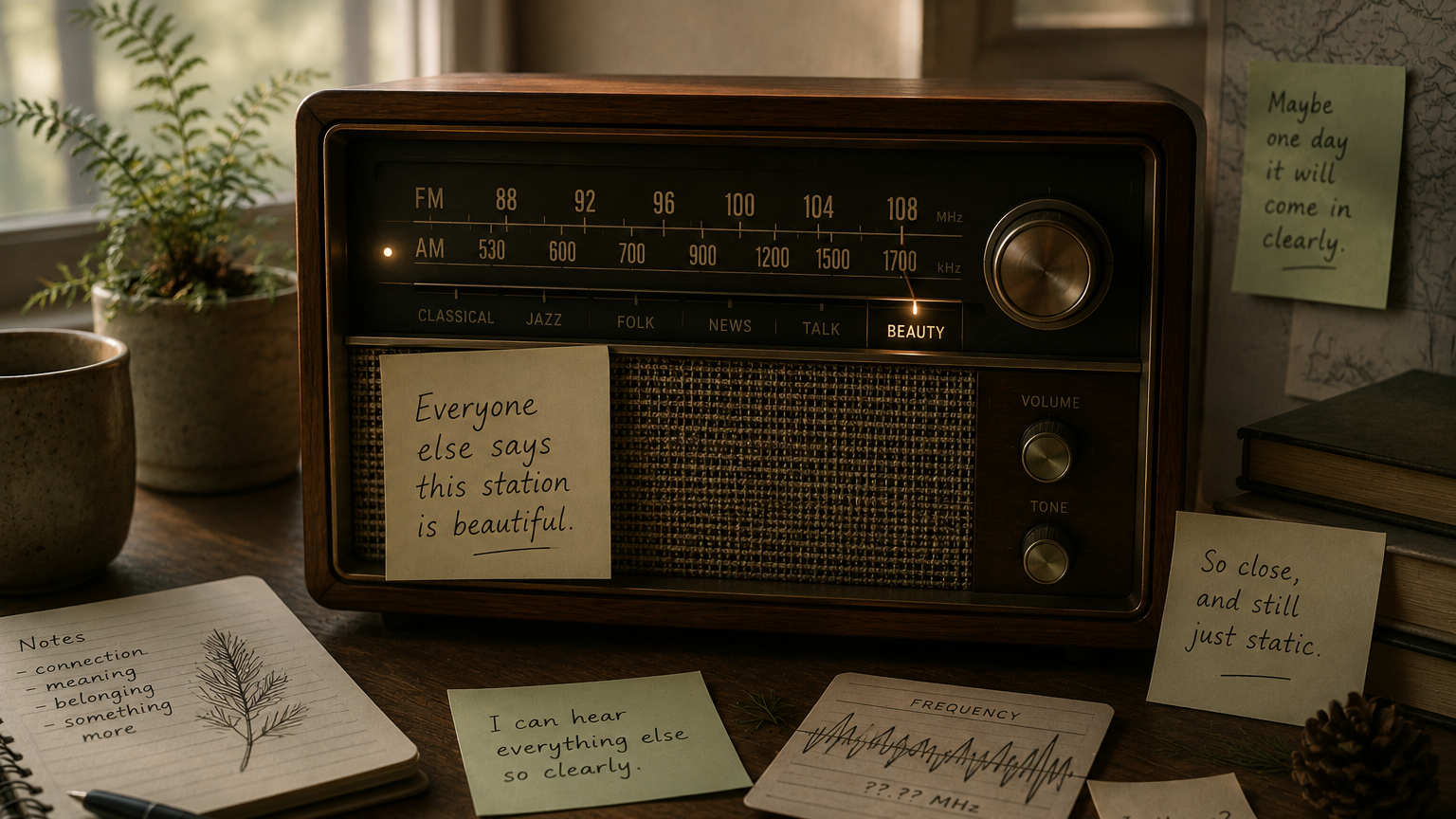
An antique radio sits beneath a lamp with its dial tuned between stations. (Created by generative AI.)
But unlike music—which reaches me—or wind—which would knock me over whether I believed in it or not—faith remains something I can behold with clarity but cannot personally access.
I learned early that there was not much tolerance for my questions about faith. At some point, those questions became read as contrary, even when they were not. I could not understand why the rules I was expected to apply everywhere else—rules of coherence, consistency, and explanation—shifted at the threshold of this one domain.
It was not just the rules. The tolerance for inquiry changed with them. Questions that would have been welcomed elsewhere were met here with hostility, sometimes disgust. My attempts to reconcile what I was being asked to accept with the rest of my understanding of the world were met with suspicion and discipline. The incongruities were never meaningfully addressed.
So, for me, faith died on the vine—an unquestionable, and therefore unadoptable, construct.
I do not pine for it. There is no faith-shaped hole in me, no sense of absence I am trying to fill. I am not waiting to be convinced, and I am not quietly searching for the right version to finally make sense. I am not less human for it, not called more quietly to justice, and not less inclined to answer another person’s need.
Still, I can see what it offers. The unity, the order, the clarity. The strength it can imbue, the comfort it can supply. I can imagine the relief possible in even a small measure of that comfort—a drop of that reassurance. That is the part I sometimes envy, like a comfort food I will never taste.
I am not naming faith here to argue against it. I am naming it because it taught me something about access. A form of care can be sincere, beautiful, and sustaining for many people while remaining unavailable to someone whose mind cannot receive it through the framework being offered.
That distinction matters.
Too often, when support does not land, the person is interpreted as resistant, disengaged, ungrateful, or unreachable. Less often do we ask whether the support itself depends on assumptions the person cannot share.
This is not limited to religion. It happens in classrooms, families, workplaces, advising offices, therapeutic settings, peer groups, and communities that sincerely want to help. Support is offered. Encouragement is given. Expectations are explained. Belonging is extended. But the form of that care may still presume a way of processing, trusting, responding, or making meaning that is not available to the person receiving it.
When that happens, the issue is not necessarily a lack of openness or effort. It may be a mismatch between the framework being used and the person it is meant to serve. That mismatch is not neutral. It shapes who experiences care as available, who experiences support as safe, and who learns to hide the parts of themselves that make receiving care difficult.
For many learners, especially those navigating both high capacity and meaningful cognitive variability, this matters. A learner may be intellectually capable and still unable to metabolize the guidance being offered. They may understand the words being said and still be unable to locate themselves within the assumptions behind those words. They may appear resistant when they are actually overwhelmed, disengaged when they are actually misaligned, or oppositional when they are trying to preserve coherence.
Vulnerability does not only emerge from lack of ability or lack of effort. It often emerges from persistent misalignment and the absence of structures that can recognize it.
I know this pattern from more than one direction. When my family and their faith community offered comfort, I could not receive it without sharing in their belief. In school, teachers trying to help offered guidance that was often ineffective for me as an AuDHD learner. Socially, I often felt as though I was on the same page as others, only to discover I was reading from a different edition of the text altogether.
All of this left me vulnerable—without space to name or explore my differences, without language for what I was experiencing, and without access to guidance grounded in an accurate understanding of me.
That is the part Woodland Pacific is built to address.
Our work is not simply to offer more support. It is to ask whether the support being offered is actually receivable by the people it is meant to serve.
This requires more than accommodation. Accommodation often begins after a system has already been built. It asks what can be adjusted so that someone can gain access to a structure designed around other assumptions. That work matters, but it is not enough.
We need forms of care, learning, and community that begin with variability rather than treating it as an exception. We need to ask how people make meaning, how they experience expectation, how they respond to uncertainty, how they receive correction, how they interpret belonging, and how they know when they are safe.
For neurodivergent and twice-exceptional learners, these questions are not abstract. They shape whether a learner is understood as intense or disruptive, curious or defiant, capable or inconsistent, gifted or struggling, promising or difficult. They shape whether the learner’s spark is protected or slowly extinguished by repeated misrecognition.

A banquet table is set with dairy foods and a single empty plate. (Created by generative AI.)
I have seen sincere invitations built around narrow assumptions about how people make meaning. It is, in effect, an all-dairy buffet offered to the lactose intolerant. When the desired response is not achieved, the conclusion is often that people are uninterested or disengaged, rather than that the offering itself may not be receivable.
Woodland Pacific begins in that gap between intention and reception.
We are concerned with the learners whose capacities are real, but whose needs are misread; whose questions are interpreted as defiance; whose intensity is mistaken for instability; whose difference is treated as a problem to manage rather than information to understand.
To accompany these learners well, we have to become more curious about mismatch. We have to resist the easy conclusion that a learner who does not respond as expected is refusing care. We have to ask whether the care being offered requires them to translate themselves before they can be helped.
Accompaniment, in this sense, is not about having the same answers, beliefs, temperament, or way of moving through the world. It is the sustained practice of remaining with someone long enough to understand how the world is reaching them, where it is failing them, and what conditions might allow them to participate more fully as themselves.
That kind of care does not require sameness. It requires attention. It requires a suspension of judgment. It requires the humility to recognize that what is nourishing to one person may be inaccessible to another. It requires us to stop asking only whether support was offered and begin asking whether it could be received.
This is how we protect the spark.
Not by asking learners to become easier to understand. Not by treating difference as a problem to solve. Not by mistaking access for indulgence or support for lowered expectations.
We protect the spark by changing the conditions under which learners are asked to learn, grow, belong, and contribute. We protect it by building spaces where variability is expected, where questions are not treated as threats, where intensity is met with interpretation rather than alarm, and where care is designed with enough flexibility to reach the people it claims to serve.
The goal is not to create a single framework that finally works for everyone. The goal is to build communities capable of noticing when their frameworks are not working—and responsive enough to change.
That is where care begins to become accessible. That is where belonging becomes more than invitation. That is where accompaniment becomes real.
